Title
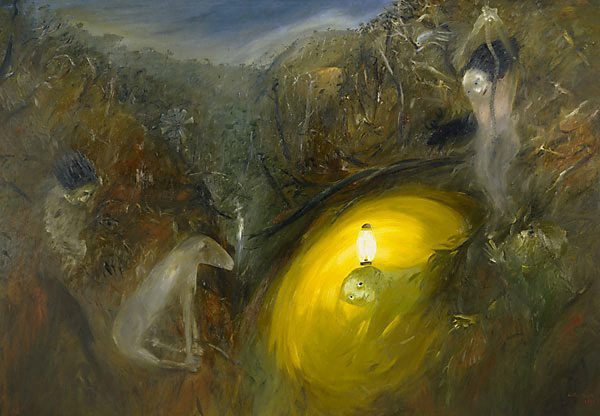
Lysistrata II
1971
Artist
-
Details
- Place where the work was made
-
Carshalton
→
London
→
England
- Date
- 1971
- Media category
- Painting
- Materials used
- oil on canvas
- Dimensions
- 300.0 x 443.0 cm
- Signature & date
Signed and dated l.r. corner, red oil "Arthur Boyd/ 1971".
- Credit
- Purchased with funds provided by Katies through the auspices of Joseph and Gerda Brender 1982
- Location
- Not on display
- Accession number
- 140.1982
- Copyright
- © Reproduced with permission of Bundanon Trust
- Artist information
-
 Arthur Boyd
Works in the collection
- Share
-


-
About
Concurrent with the publication of the portfolio of Lysistrata etchings at the end of 1970, Boyd was commissioned by St. Helier Hospital in Carshalton, London to paint these two large works for the library.
An interest in ancient Greek myths and literary themes developed during the sixties and the story of Lysistrata, by the playwright Aristophanes, accommodated Boyd's enduring theme of conflict between opposing forces, in this case sexual desire and anti-war sentiment.
In the play, an Athenian woman - Lysistrata, 'dismisser of armies' - persuades the women of Athens to abstain from sexual relations with their husbands until the war with Sparta ends, successfully forcing a conclusion to the hostilities.
Boyd, however, chooses to depict a woman who breaks from her self-imposed internment and makes way in the dead of night to meet her husband, symbolically waiting near the cave of Pan, the ancient god of love. The intense yellow glow of the bright lantern within the grotto illuminates the seated dog to the left of the cave opening. Used often by Boyd in his earlier paintings, the haunting image of the sitting dog is a classical symbol of the spiritual guardian of humanity.
-
Exhibition history
Shown in 2 exhibitions
Arthur Boyd retrospective (1993-1994), Art Gallery of New South Wales, Sydney, 15 Dec 1993–06 Mar 1994
Arthur Boyd retrospective (1993-1994), National Gallery of Victoria [St Kilda Road], Melbourne, 30 Mar 1994–23 May 1994
Arthur Boyd retrospective (1993-1994), Tasmanian Museum and Art Gallery, Hobart, 09 Jun 1994–21 Aug 1994
Arthur Boyd retrospective (1993-1994), Art Gallery of Western Australia, Perth, 22 Sep 1994–20 Nov 1994
Australian icons: twenty artists from the collection, Art Gallery of New South Wales, Sydney, 04 Aug 2000–03 Dec 2000
-
Bibliography
Referenced in 3 publications
-
Janet McKenzie, Arthur Boyd: Art and life, 'Experimentation: Graphic work', pg. 116-129, London, 2000, 129.
-
Barry Pearce, Arthur Boyd retrospective, Sydney, 1993, 127 (illus. colour). cat.no. 111
-
Barry Pearce, Look, 'The legacy in Sydney Arthur Boyd', pg. 18-20, Melbourne, Jul 1999, 20.
-