-
Details
- Place where the work was made
-
China
- Period
- Qing dynasty 1644 - 1911 → China
- Date
- 18th century
- Media categories
- Scroll , Painting
- Materials used
- hanging scroll; ink on paper
- Dimensions
- 129.5 x 61.0 cm image; 260.0 x 92.0 cm scroll
- Signature & date
Signed u.l. corner, in Chinese, incribed in black ink, "Xinlo shanren painted and inscribed."
Signed, in Chinese , stamped in red ink "hua yan, qiu yue, Kong chen shi hua, tai su dao ren [four artist's seals]" Not dated.- Credit
- Purchased with funds provided by the Art Gallery Society of New South Wales 1993
- Location
- Not on display
- Accession number
- 570.1993
- Copyright
- Artist information
-
Hua Yan
Works in the collection
- Share
-


-
About
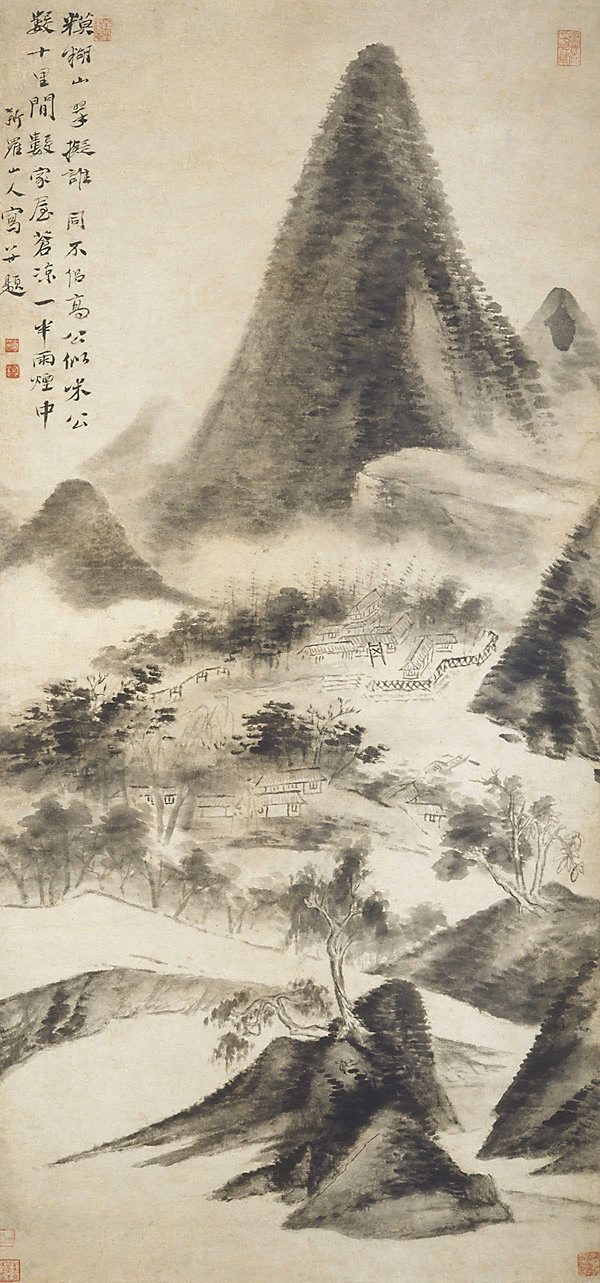
This painting is in the style of the gifted landscapist Mi Fu (1052-1109), a member of an 11th-century coterie of scholar-artists who formulated the literati (wenrenhua) theory the value of a painting lies not in its simulation of nature but in its transformation of nature into a vehicle that expresses the character and mood of the painter. For centuries this theory shaped the style of the scholar-amateur literati artists who worked in ink only. They scorned mere representation, aspiring to a deliberate awkward-looking style full of archaic reference tempered by an astringent intellectualism. In 18th-century Yanzhou, a wealthy class of merchants who sought to emulate the taste of the scholar-gentry class commissioned paintings in the literati style, such as this fine example by Hua Yan. One of the ‘Eccentric Master of Yangzhou’, a loose group of artists producing their own unorthodox interpretations of literati painting, Hua Yan was noted for the virtuosity of his brushwork. By his time the Mi Fu style of building up landscape forms by a series of dots (particularly obvious in his mountains) was a classic in the stylistic vocabulary of literati artists.
‘The Asian Collections: Art Gallery of New South Wales’. pg.150.
© 2003 Trustees, Art Gallery of New South Wales -
Places
Where the work was made
China
-
Exhibition history
Shown in 3 exhibitions
Great gifts, great patrons, Art Gallery of New South Wales, Sydney, 17 Aug 1994–19 Oct 1994
Art of the brush, Art Gallery of New South Wales, Sydney, 23 Sep 1995–12 Nov 1995
Conversations through the Asian collections, Art Gallery of New South Wales, Sydney, 25 Oct 2014–13 Mar 2016
-
Bibliography
Referenced in 7 publications
-
Art Gallery of New South Wales, Great gifts, great patrons: an exhibition celebrating private patronage of the Gallery, Sydney, 1994. no catalogue numbers
-
Edmund Capon, Look, 'Society's Gift to the Gallery', pg. 12-13, Heidelberg, Apr 1994, cover (colour illus.), 12, 13 (colour illus.). The colour illus. on the cover is a detail of this work.
-
Bruce James, Art Gallery of New South Wales handbook, 'Asian Collection: East Asia', pg. 246-287, Sydney, 1999, 256 (colour illus.).
-
Jackie Menzies, Art of the Brush - Chinese & Japanese painting calligraphy, Sydney, 1995, 8 (illus.), 9.
-
Jackie Menzies (Editor), The Asian Collections Art Gallery of New South Wales, 'Landscape Painting', Sydney, 2003, 150-151 (colour illus.). The colour illus. on page 151 is a detail of this work.
-
Jackie Menzies, AGNSW Collections, 'Asian Art - India, South-East Asia, China, Tibet, Korea, Japan', pg. 173-228, Sydney, 1994, 201 (colour illus.).
-
Lisa Slade and Rachael Kirsten, Enter Art, Sydney, 2000, sheet number 6 (colour illus.). Education kit produced by the NSW Dept of Education and Training as teaching resource for primary school teachers.
-