-
Details
- Other Titles
- Bhaishajyaguru, the Medicine Buddha
The Medicine Buddha (Bhaishajyaguru) - Place where the work was made
-
Tibet
- Cultural origin
- Menri style
- Date
- 19th century
- Media category
- Painting
- Materials used
- thangka; distemper and gold on sized cotton
- Dimensions
- 66.0 x 43.0 cm image; 125.0 x 69.0 cm overall
- Signature & date
Not signed. Not dated.
- Credit
- Purchased with funds provided by the David George Wilson Bequest for Asian Art 1999
- Location
- Not on display
- Accession number
- 67.1999
- Copyright
- Artist information
-
Menri style
Works in the collection
- Share
-


-
About
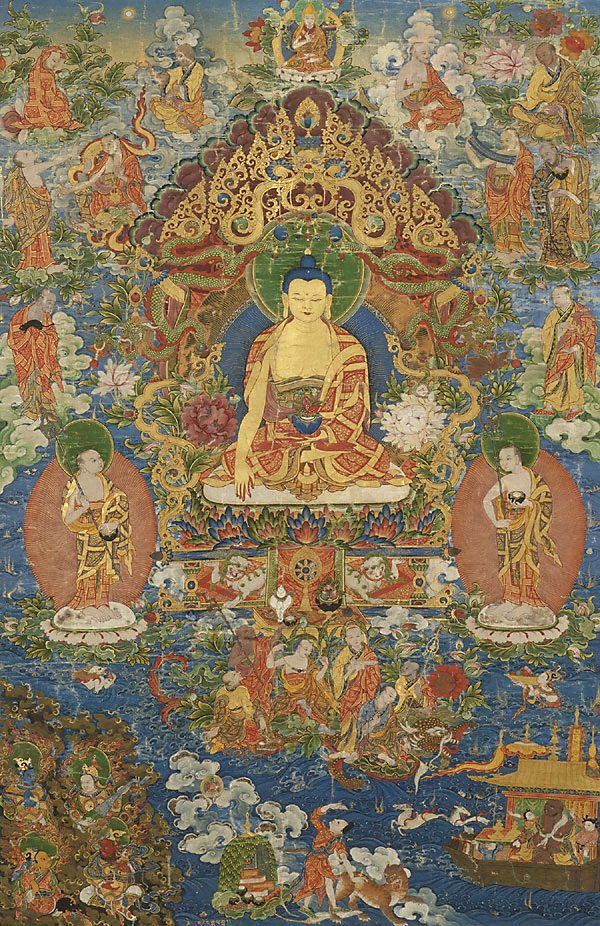
This 'thangka' is distinctive for its use of rich and intense colour, predominantly blue, gold and green. The central deity holds a begging bowl containing a sprig of the medicinal myrobalan plant. Seated on a lotus pedestal supported on a lion throne, the Medicine Buddha wears the patched robes of a monk and is accompanied by his disciples and the 18 'arhats' or 'saints' of Tibetan Buddhism. Directly above the Buddha's head is Tsong Khapa, an important reformer of Buddhism in Tibet and the founder of the Gelukpa or 'Yellow Hat' order of monks. A 'thangka' such as this may have been commissioned to commemorate a significant occasion or life ceremony, to accrue merit for the donor or as homage to the abbot. The dedication of an image of the Medicine Buddha may suggest that it was commissioned at a time of illness, or perhaps as a wish for good health.
Interestingly, this 'thangka' bears an inscription which indicates that it was painted at the Tsedong monastery in Tsang, Central Tibet, for Ride Gdong Sprul Sku, who was the reincarnated abbot ('lama') of that monastery. Although it is not known who commissioned it and what their relationship was to the abbot, it is not unusual to find 'thangkas' with dedications or inscriptions recording the names of donors and the circumstances surrounding the commission. This inscription reminds us of the 'thangka's' donative function, as works created as a tribute designed to bring merit to oneself and others.
The Asian Collections, AGNSW, 2003, pg.64.
-
Places
Where the work was made
Tibet
-
Exhibition history
Shown in 4 exhibitions
6th Semi Annual New York Arts of Pacific Asia Show, The 26th Street Armory at Lexington Avenue, New York, 24 Mar 1999–28 Mar 1999
Buddha: Radiant awakening, Art Gallery of New South Wales, Sydney, 10 Nov 2001–24 Feb 2002
Glorious, Art Gallery of New South Wales, Sydney, 27 May 2017–06 Jan 2019
Elemental, Art Gallery of New South Wales, Sydney, 30 Jul 2022–2024
-
Bibliography
Referenced in 10 publications
-
Adam Geczy, Art Asia Pacific [Issue 35], 'Buddha: Radiant awakening', pg. 29-31, St Leonards, Jul 2002-Sep 2002, 29, 30 (colour illus.), 31.
-
Jackie Menzies, Arts of Asia, 'New Dimensions', pg. 54-63, Hong Kong, Nov 2003-Dec 2003, 63 (colour illus.). no.21
-
Jackie Menzies (Editor), Buddha: Radiant awakening, Sydney, 2001, 126, 127 (colour illus.),187. cat.no. 92
-
Jackie Menzies (Editor), The Asian Collections Art Gallery of New South Wales, Sydney, 2003, 64-65 (colour illus.). The colour illus. on page 65 is a detail of this work.
-
Jackie Menzies (Co-ordinator), The arts of Buddhism, Sydney, 2001, front cover (colour illus.). The image that appears in this publication is a detail of this work.
-
Justin Paton, Look, 'Conversations. A new way to engage with the Gallery's Asian art', pg 22-13, Sydney, Oct 2014, 23.
-
Jill Sykes, Look, 'Buddha rules', pg. 13, Melbourne, Sep 2001, 13 (colour illus.).
-
Jill Sykes, Look, 'Looking forward to 2015', Sydney, Nov 2014, 15 (colour illus.).
-
Michael Wardell, Look, 'Thanks to a generous benefactor', pg. 14-15, Sydney, Nov 2003, 14 (colour illus.), 15.
-
Judith White, Look, 'A landmark for the city', pg. 16-19, Melbourne, Apr 2001, 18 (colour illus.). The image appearing in this publication is a detail of the work.
-
-
Provenance
Soo Tze Oriental Antiques, pre 1999, Hobart/Tasmania/Australia, purchased by the Art Gallery of New South Wales, Sydney, April 1999.