Title
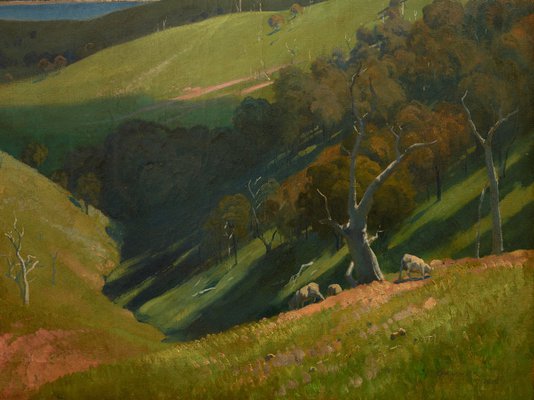
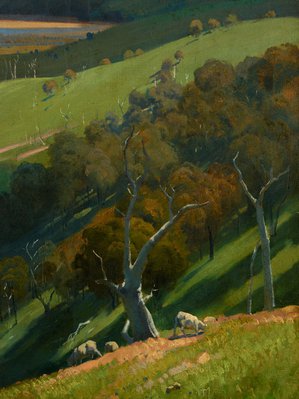
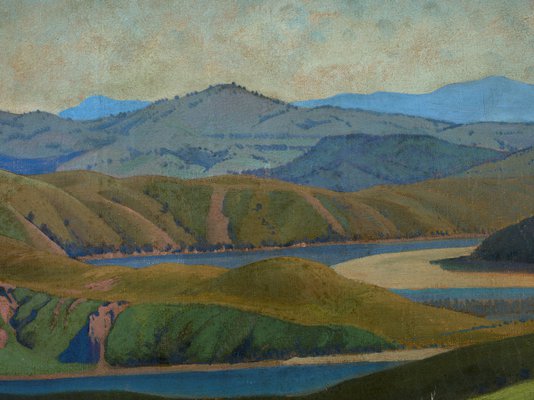
On the Murrumbidgee
1929
Artist



-
Details
- Date
- 1929
- Media category
- Painting
- Materials used
- oil on canvas
- Dimensions
-
101.6 x 123.2 cm stretcher; 131.5 x 152.5 x 12.0 cm frame
:
0 - Whole, 100.5 x 121.8 cm, SIGHT DIMENSION
- Signature & date
Signed and dated l.r. corner, grey oil "GRUNER/ 1929".
- Credit
- Purchased 1930
- Location
- Not on display
- Accession number
- 840
- Copyright
- Wynne Prize
- Winner - 1929
- Artist information
-
Elioth Gruner
Works in the collection
- Share
-


-
About
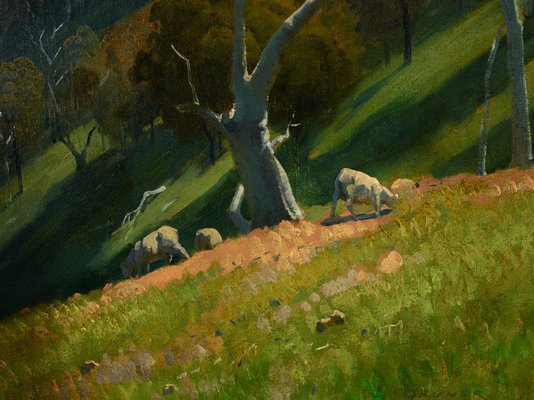
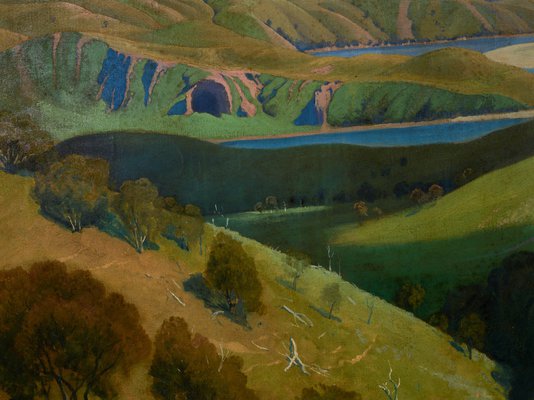
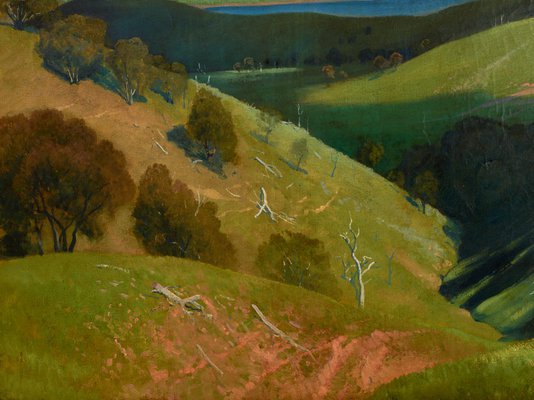
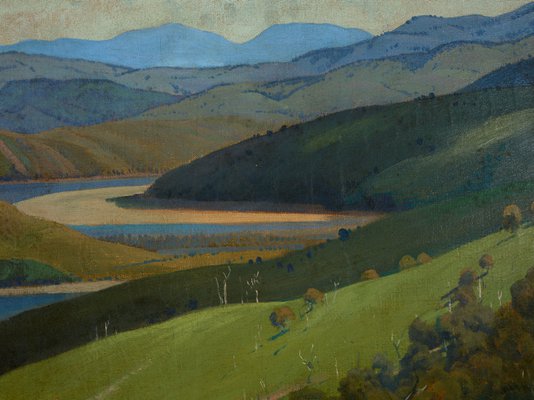
The sweeping mountainscapes of Gruner and Heysen of the 1920s were symbolic expressions of a pastoral utopia in which a purism of form - 'the simplification and reduction to essentials' - which evolved from the modernism of Europe, was adopted to suggest the spirit and essence of the landscape.
Gruner's work became more severe in form and outline during this period, emphasising subtle harmonies of tone and colour and creating a feeling of stability and permanence, in contrast to his previous explorations into the evanescence of light and colour.
"Form becomes of equal consideration with light, and his work is now more carefully organised, extremely simple, less immediate in direct emotional appeal, but infinitely more pictorial. Gruner has substituted the science of picture making for the science of painting light, preserving, however, that sense of light which made his earlier pictures remarkable ...".
Basil Burdett, 1929Australian Art Department, AGNSW, 2001
This painting won the Wynne Prize in 1929 and was acquired by the Gallery in 1930.
-
Exhibition history
Shown in 13 exhibitions
The Wynne Art Prize 1929, Art Gallery of New South Wales, Sydney, 17 Jan 1930–17 Feb 1930
Loan exhibition of the works of Elioth Gruner (1932), National Art Gallery of New South Wales, Sydney, 21 Dec 1932–21 Feb 1933
150 years of Australian art (1938), National Art Gallery of New South Wales, Sydney, 27 Jan 1938–25 Apr 1938
A retrospective exhibition of Australian painting, Art Gallery of New South Wales, Sydney, 25 Sep 1953–25 Oct 1953
Elioth Gruner 1882-1939 (1983), Art Gallery of New South Wales, Sydney, 13 Jul 1983–04 Sep 1983
Two centuries of Australian painting, a selection from the Art Gallery of New South Wales, Orange Regional Gallery, Orange, 19 Apr 1986–15 Jun 1986
The Wynne prize: an Australian landscape tradition (1987), S.H. Ervin Gallery, The Rocks, 19 Dec 1986–01 Feb 1987
The Wynne prize: an Australian landscape tradition (1987), Lake Macquarie City Art Gallery, Booragul, 06 Mar 1987–29 Mar 1987
The Wynne prize: an Australian landscape tradition (1987), Orange Regional Gallery, Orange, 10 Apr 1987–17 May 1987
The Wynne prize: an Australian landscape tradition (1987), Griffith Regional Art Gallery, , 03 Jun 1987–20 Jun 1987
The Wynne prize: an Australian landscape tradition (1987), Wagga Wagga Art Gallery, Australia, 01 Jul 1987–26 Jul 1987
The Wynne prize: an Australian landscape tradition (1987), Albury Regional Gallery, Albury, 07 Aug 1987–06 Sep 1987
The Wynne prize: an Australian landscape tradition (1987), Broken Hill City Art Gallery, Broken Hill, 18 Sep 1987–26 Oct 1987
The Wynne prize: an Australian landscape tradition (1987), Tamworth City Gallery, Tamworth, 05 Nov 1987–13 Dec 1987
Two hundred years of Australian painting : Nature, people and art in the southern continent, National Museum of Western Art, Tokyo, Japan, 28 Apr 1992–28 Jun 1992
Two hundred years of Australian painting : Nature, people and art in the southern continent, The National Museum of Modern Art, Kyoto, Kyoto, 14 Jul 1992–06 Sep 1992
Leaping boundaries: a century of New Zealand artists in Australia, Mosman Art Gallery, Mosman, 09 Jun 2001–17 Jul 2001
Parallel Visions: Twenty-two artists from the Australian collection, Art Gallery of New South Wales, Sydney, 22 Feb 2002–May 2003
The Big River Show - Murrumbidgee Riverine, Wagga Wagga Art Gallery, Australia, 11 Oct 2002–01 Dec 2002
Elioth Gruner: the texture of light, Canberra Museum and Art Gallery, Canberra, 08 Mar 2014–22 Jun 2014
Elioth Gruner: the texture of light, Newcastle Art Gallery, Newcastle, 26 Jul 2014–26 Oct 2014
On Wiradjuri Country, Albury Regional Gallery, Albury, 02 Oct 2015–06 Dec 2015
-
Bibliography
Referenced in 26 publications
-
Art Gallery of New South Wales, A selection of eighty-two reproductions mainly from the Australian collection and including examples from the British, French and Dutch [Art Gallery of New South Wales], Sydney, 1959, (colour illus.). plate no. 29
-
Helen Campbell, Wynne centenary 1897-1997: a selection of past winners from the Gallery's collection, Sydney, 1997. not paginated
-
Deboarh Clark, Elioth Gruner: the texture of light, 'Elioth Gruner: the texture of light', pg. 9-89, Canberra, 2014, 61 (colour illus.), 70, 96, 100.
-
Dinah Dysart, The Wynne prize: an Australian landscape tradition, 'The public and critical response to the Wynne prize', pg. 15-22, Sydney, 1986, 18, 25.
-
Deborah Edwards, Two centuries of Australian painting: a selection from the Art Gallery of New South Wales, 'Introduction', pg. 8-14, Sydney, 1986, 32 (illus.). cat.no. 32
-
Gould Galleries Melbourne, Director's choice 2005: celebrating 25 years of Gould Galleries with an exhibition of 25 significant works, South Yarra, 2005. cat.no. 7; 'Study for "On the Murrumbidgee"', 1929, oil on canvas
-
Lou Klepac, Parallel visions: works from the Australian collection, 'Hans Heysen / Elioth Gruner / Horace Trennery', pg. 32-47, Sydney, 2002, 143.
-
Lionel Lindsay, 150 years of Australian art, Sydney, 1938, (illus.). cat.no. 38; not paginated
-
J. S. MacDonald., Australasian post, 'Gruner exhibition', Melbourne, 21 Jan 1933, unknown. Exhibition review
-
Humphrey McQueen, Hemisphere, 'Humbly anonymous', 36-41., Australian Capital Territory, Apr 1979, 41 (colour illus.).
-
Hal Missingham., Hemisphere: an Asian-Australian magazine, 'Paintings by Australian artists', Sydney, May 1957, 17 (illus.).
-
William Moore, The story of Australian art from the earliest known art of the continent to the art of today (Vol. 1), Sydney, 1934, frontispiece (colour illus.).
-
National Art Gallery of New South Wales, Loan exhibition of the works of Elioth Gruner, Sydney, 1932. cat.no. 18
-
Barry Pearce and Haruo Arikawa, Two hundred years of Australian painting: nature, people and art in the southern continent, Tokyo, 1992, 123 (colour illus.). cat.no. 72
-
Barry Pearce, Elioth Gruner 1882-1939, Sydney, 1983, 52 (illus.). cat.no. 58
-
Julie Roberts, Art and Australia (Vol. 37, No. 2), 'Seeing the light', pg. 222-231, Sydney, Dec 1999-Feb 2000, 229 (colour illus.), 230.
-
Bernard William Smith and Terry Smith, Australian painting 1788-1990, 'Leviticus 1913-32', pg. 167-204, South Melbourne, 1991, 188 (illus.). illus.no. 108
-
Bernard William Smith, A catalogue of Australian oil paintings in the National Art Gallery of New South Wales 1875-1952, Sydney, 1953, 83. cat.no. 238
-
Bernard William Smith, Place, taste and tradition: a study of Australian art since 1788, 'The modern movement in Australia', pg.181-213, South Melbourne, 1979, 142 (illus.), 186. plate no. 52; titled 'The Murrumbidgee Ranges'
-
Sotheby's Australia, Sotheby's Melbourne: important Australian art (24 & 25 August 2009), Melbourne, 2009, 15 (colour illus.). lot no. 6 is titled 'Study for 'On the Murrumbidgee''.
-
Beatrice Tildesley, Sydney mail, 'The Gruner exhibition at the National Art Gallery', pg. 17, Sydney, 28 Dec 1932, 17. Exhibition review
-
Gavin Wilson, The Big River show: Murrumbidgee Riverine, Wagga Wagga, 2002, 12, 13 (colour illus.), 82.
-
Editor Unknown (Editor), The Sydney morning herald, 'Art Gallery's Gruner exhibition', pg. 12, Sydney, 20 Dec 1932, 12 (illus.). Photograph depicts artist and former gallery director, J S MacDonald, advising two installation staff on the hanging of this painting
-
Editor Unknown (Editor), Weekend advertiser, 'River of Wagga's dreams', pg. 24, Wagga Wagga, 12 Oct 2002-13 Oct 2002, 24.
-
Editor Unknown (Editor), The Sydney morning herald, 'Elioth Gruner exhibition: memorial to a master', pg. 6, Sydney, 17 Apr 1940, 6.
-
Editor Unknown (Editor), The Sydney morning herald, '"On the Murrumbidgee"', pg. 13, Sydney, 08 Mar 1930, 13 (illus.).
-