Title
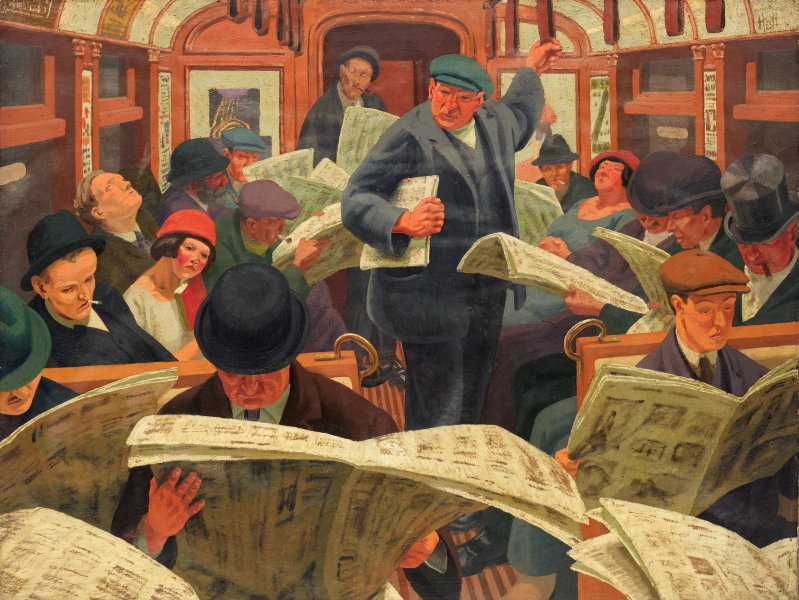
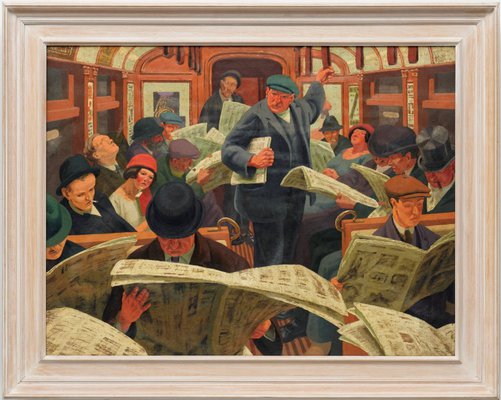
(Morning underground)
1922
Artist
-
Details
- Date
- 1922
- Media category
- Painting
- Materials used
- oil on canvas
- Dimensions
- 76.0 x 100.0 cm stretcher; 96.7 x 120.7 x 6.5 cm frame
- Signature & date
Signed and dated u.r. corner, brown (oil?) "HWH 22".
- Credit
- Purchased 1976
- Location
- South Building, ground level, 20th-century galleries
- Accession number
- 90.1976
- Copyright
- © Estate of HF Weaver Hawkins
- Artist information
-
 Weaver Hawkins
Works in the collection
- Share
-


-
About
Australian artists who, in previous decades, had taken to the bush in search of motifs which served as keynotes for Australian life and landscape, entered the decade of the 1920s with a new impetus, embracing all that the modern, mechanised city had to offer. Urban and residential development, which transformed the provincial outpost of Sydney into the sprawling metropolis of the 1930s, was to prove inspirational for many artists of this period.
As bridges, buildings and other spectacles of engineering began to soar towards the skies, artists such as Grace Cossington Smith and Margaret Preston adopted pictorial approaches drawn from sources as diverse as Cézanne, Gauguin, Matisse, van Gogh, and to a lesser extent, the Cubists, in an attempt to reconcile industrial expansion with orthodox visions of an antipodean Arcady. For many of these artists, however, the portrayal of the modern city was a triumphant declaration of colour as the foundation of form.
Weaver Hawkins, who arrived in Australia in 1935, brings the claustrophobic confines of modern living to the fore in his densely populated canvas, 'Morning underground', which depicts commuters travelling on the London Underground.
Australian Art Department, AGNSW, 2001
-
Exhibition history
Shown in 5 exhibitions
Project 11 - Weaver Hawkins (1976), Art Gallery of New South Wales, Sydney, 07 Feb 1976–14 Mar 1976
Patrick White's choice, Art Gallery of New South Wales, Sydney, 22 Dec 1981–31 Jan 1982
Paint on the tracks: Australian artists and the railway, S.H. Ervin Gallery, The Rocks, 22 Apr 1994–29 May 1994
Weaver Hawkins retrospective, Newcastle Art Gallery, Newcastle, 25 Oct 1994–20 Dec 1994
Weaver Hawkins retrospective, S.H. Ervin Gallery, The Rocks, 02 Jun 1995–16 Jul 1995
20th-Century galleries, ground level (rehang), Art Gallery of New South Wales, Sydney, 20 Aug 2022–2023
-
Bibliography
Referenced in 6 publications
-
Deborah Edwards, Australian art: in the Art Gallery of New South Wales, 'Moderns', pg. 103-104, Sydney, 2000, 116 (colour illus.), 300.
-
Gavin Fry, Paint on the tracks: Australian artists and the railway, 'Introduction', pg. 7-10, Sydney, 1994, 9 (illus.), 48. cat.no. 10
-
Helen Verity Hewitt, Patrick White, painter, manqué: paintings, painters and their influence on his writing, 'Patrick White's choice', pg. 114-119, Carlton, 2002, 115.
-
Steven Miller and Eileen Chanin, The art and life of Weaver Hawkins, Chapter three '1919-1935', pg. 38-56, Sydney, 1995, 40, 104, 105 (colour illus.), 220. plate no. 1
-
Daniel Thomas AM, Project 11: Weaver Hawkins, Sydney, 1976. cat.no. 6
-
Patrick White, Patrick White's Choice, Sydney, Dec 1981, illus.. cat.no. 3
-