Title
Djan'kawu creation story, from the series Djan'kawu story
(1959)
Artists

-
Details
- Other Titles
- Djannggawo myth no. 1
Djanggawul myth no. 1
Djanggawull myth no. 1
Djang'kawu story no. 1
Djanggawul Myth. The journey from Buralgo to Jelangbarra - Place where the work was made
-
Yirrkala
→
North-east Arnhem Land
→
Northern Territory
→
Australia
- Date
- (1959)
- Media category
- Bark painting
- Materials used
- natural pigments on bark
- Dimensions
- 191.8 x 69.8 cm (irreg.)
- Signature & date
Not signed. Not dated.
- Credit
- Gift of Dr Stuart Scougall 1959
- Location
- Not on display
- Accession number
- IA64.1959
- Copyright
- © Estate of the artists. Licensed by Aboriginal Artists Agency Ltd
- Artist information
-
Mawalan Marika
Works in the collection
- Artist information
-
Wandjuk Marika
Works in the collection
- Artist information
-
Mathaman Marika
Works in the collection
- Artist information
-
Waḏaymu Ganambarr
Works in the collection
- Share
-


-
About
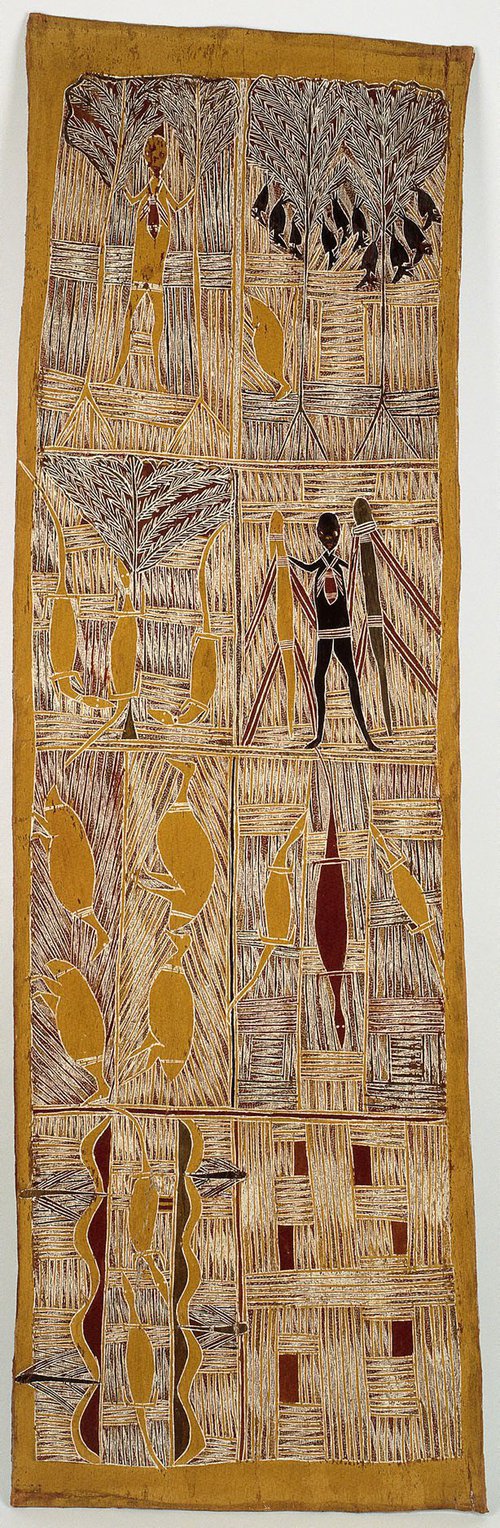
This painting, the first of the series, depicts the journey of Djan'kawu and his two sisters from Burralku, an island far to the east, and their arrival at Yalangbara (Port Bradshaw). The Djan'kawu, as they are collectively known, are the principal Dhuwa moiety creation ancestors. The four other paintings depict aspects of their journey through eastern Arnhem Land. During their travels on land they name and make sacred animals, vegetation and places. The Sisters give birth to the people and institute the ritual of the Dhuwa moiety Ngärra ceremonies.
bottom right: Djan'kawu at Burralku. He wears a waistband of feathered string and has cicatrices on his chest. Djan'kawu carries two mawalan (walking sticks) decorated with parakeet feather pendants and bound with string. Where the mawalan is inserted in the ground spring water gushes forth. A brolga is depicted above Djan'kawu on the clay pan ready to fly away.
bottom left: As they approach Yalangbara (Port Bradshaw) they look back and see the Morning Star which has guided them. Later, as they arrive at Yalangbara they look back and see the sun rising.
lower right: A large sea creature, also representing a ngainmara or conical mat, is shown floating in the sea.
lower left: The Djan'kawu see a thunder cloud. The Thunder Man, Djambuwal, is urinating and forming a waterspout between the clouds and the sea.
upper right: Djan'kawu and the two women in their bark canoe. The fish is a garfish seen on their journey.
upper left: top: Shows a male whistling duck, a female and chick.
top right: Djan'kawu depicted with sacred Mawalan (walking sticks).
top left: The Djan'kawu at the rocks at Gulbinbuy are depicted by the diagonal lines. They hear the flying foxes in a sacred Gadmura tree. They hear the black mangrove bird and the morning pigeon in the mangroves. They see a lizard. The oval shapes are trepang (sea cucumber).
The cross-hatching represents aspects of the environment including marks made by the dancing brolga and by it digging for worms in the ground. Other interpretations of the cross-hatching are clouds, sunlight on the sand, rain, the wake from the stern of the canoe, waves breaking, sea foam, different kinds of water and a swimming duck.
© Information provided by the artist
Australian Art Department, AGNSW, 2000
-
Places
Where the work was made
Yirrkala
-
Exhibition history
Shown in 7 exhibitions
Australian Aboriginal art: bark paintings, carved figures, sacred and secular objects: an exhibition arranged by the State art galleries of Australia, 1960-1961, Art Gallery of New South Wales, Sydney, 17 Aug 1960–18 Sep 1960
Australian Aboriginal art: bark paintings, carved figures, sacred and secular objects: an exhibition arranged by the State art galleries of Australia, 1960-1961, Queensland Art Gallery, South Brisbane, Oct 1960–Oct 1960
Australian Aboriginal art: bark paintings, carved figures, sacred and secular objects: an exhibition arranged by the State art galleries of Australia, 1960-1961, National Gallery of Victoria [Swanston Street], Melbourne, Nov 1960–Dec 1960
Australian Aboriginal art: bark paintings, carved figures, sacred and secular objects: an exhibition arranged by the State art galleries of Australia, 1960-1961, Western Australian Art Gallery, Perth, Feb 1961–Mar 1961
Australian Aboriginal art: bark paintings, carved figures, sacred and secular objects: an exhibition arranged by the State art galleries of Australia, 1960-1961, National Gallery of South Australia, Adelaide, Apr 1961–Apr 1961
Australian Aboriginal art: bark paintings, carved figures, sacred and secular objects: an exhibition arranged by the State art galleries of Australia, 1960-1961, Tasmanian Museum and Art Gallery, Hobart, May 1961–Jun 1961
Australian icons: twenty artists from the collection, Art Gallery of New South Wales, Sydney, 04 Aug 2000–03 Dec 2000
ochre: bark paintings from the Collection (2000-01), Art Gallery of New South Wales, Sydney, 02 Nov 2000–06 May 2001
Yalangbara, Art Gallery of New South Wales, Sydney, 11 May 2006–23 Jul 2006
Open Air: Portraits in the landscape, National Portrait Gallery [Parliamentary Zone], Canberra, 04 Dec 2008–01 Mar 2009
Yalangbara: art of the Djang'kawu, National Museum of Australia, Canberra, Canberra, 09 Dec 2010–25 Sep 2011
Yalangbara: art of the Djang'kawu, Museum and Art Galleries of the Northern Territory, Darwin, 26 Nov 2011–17 Jun 2012
Yalangbara: art of the Djang'kawu, Western Australian Museum, Perth, 17 Nov 2012–24 Feb 2013
Maḏayin:Eight Decades of Aboriginal Bark Paintings from Yirrkala, Hood Museum of Art, Dartmouth College, United States of America, 16 Sep 2022–04 Dec 2022
Maḏayin:Eight Decades of Aboriginal Bark Paintings from Yirrkala, American University Museum, Washington D.C., 28 Jan 2023–21 May 2023
-
Bibliography
Referenced in 7 publications
-
Frederick D. McCarthy, Australian Aboriginal art: bark paintings, carved figures, sacred and secular objects: an exhibition arranged by the State art galleries of Australia, 1960-1961, 'Introduction', pg. 7-17, Sydney, 1960, 28. cat.no. 70
-
W.J.T. Mitchell, What do pictures want?, Chicago, 2005, 242 (illus.). figure no. 51
-
Margo Neale, Yiribana: Aboriginal and Torres Strait Islander collection, Sydney, 1994, 34 (colour illus.), 36, 37 (colour illus.), 137, 138. plate no. 14
-
Hetti Perkins and Ken Watson, Aboriginal art collections: highlights from Australia's public museums and galleries, 'Art Gallery of New South Wales, Sydney', pg. 40-45, Sydney, 2001, 41 (colour illus.).
-
John Saxby and Michael Brand, Look, 'The director's tour', pg. 18-20, Sydney, Aug 2015, 20 (colour illus.).
-
J.A. Tuckson, Art Gallery of New South Wales Quarterly, 'Making a bark painting', pg. 34-36, Sydney, Jul 1960, 3, 4 (illus.). Photo of the artists on page 3.; titled 'Djanggawul Myth. The journey from Buralgo to Jelangbarra'.
-
Margie West (Editor), Yalangbara: art of the Djang'kawu, Darwin, 2008, 72 (colour illus.), 73. NOTE: On page 73 there is a photo of the artist and this painting.
-