-
Details
- Alternative title
- Après le bain Femme s'essuyant
- Date
- circa 1900
- Media category
- Drawing
- Materials used
- charcoal on tracing paper mounted on board
- Dimensions
- 73.7 x 59.8 cm sight; 94.0 x 81.0 x 8.5 cm frame
- Signature & date
Not signed. Not dated.
- Credit
- Margaret Hannah Olley Art Trust 1994
- Location
- Not on display
- Accession number
- 222.1994
- Copyright
- Artist information
-
Edgar Degas
Works in the collection
- Share
-


-
About
From the very beginning of his artistic life, Degas was inculcated into the academic tradition, as taught to him by a pupil of Ingres, and absorbed through his own study and copying of the old masters. When as a student he did meet Ingres, the revered classicist’s advice stayed with Degas for the whole of his career: ‘Draw lines, young man, many lines, from nature and from memory, and you will become a good artist.’ Degas was the most dedicated of draughtsmen, yet as a progressive artist possessed of an urgent sense of the modernity of his own culture, his work was to be far from classical.
Degas met Édouard Manet in the early 1860s, and the latter’s influence undoubtedly encouraged him towards the direction followed by the future Impressionist group, with their interest in contemporary subjects. Degas saw himself primarily as a Realist, and became a penetrating observer of modern life in Paris – café-concerts, racecourses, the ballet and the brothel all constituted his favourite subjects. However, Degas’s difference from the other Impressionists, in terms of his focus on the human figure and his dedication to drawing, became increasingly evident. Although he exhibited with the Impressionists until 1886, he was not in sympathy with their theories and practices.
As he approached the late phase of his career, Degas retreated more and more into the private world of his studio, devoting himself obsessively to the theme of nude women performing the most intimate rituals of their toilette. He also preferred to work in pastel and charcoal: media that allowed Degas – whose eyesight was steadily failing – to produce broad, expressive effects and cover large areas of the paper with ease and speed.
In the last Impressionist exhibition, the artist presented a group of large pastels, described in the catalogue as a ‘series of female nudes bathing, washing, drying themselves, wiping themselves, combing their hair or having their hair combed’. The compositions were remarkably daring to 19th-century eyes, showing naked models with a startling frankness and detachment that eschewed idealisation and the conventional eroticism or moralising overtones associated with renditions of the female nude. Degas later recounted to the writer George Moore that ‘hitherto the nude has always been represented in poses which presuppose an audience, but these women of mine are honest and simple folk, who only concern themselves with their physical condition … It is as if you looked through a key-hole’.
When the works were exhibited they attracted considerable critical response; many commentators saw them as obscene representations of modern prostitutes, since it was unthinkable, literally, for middle-class women to be depicted in such a way. Other critics suggested the models’ animality, and likened some of their poses to frogs squatting down in tubs of water.
Through the 1890s and into the new century, Degas reworked the theme of nude bathers with programmatic repetition, restlessly exploring variations in posture and position through a bolder, more expressive drawing style. He worked almost exclusively in charcoal on smooth tracing paper, materials that enabled him to delineate the female nude with long, sleek, unbroken contours, combined with vigorous hatchings – which could be easily smudged and blended – for the internal modelling of the forms. The use of ordinary tracing paper further enabled Degas to create new bases on top of which he could repeat existing compositions, or adapt and develop them in new variations – a working practice he increasingly adopted during his later years, when he was endlessly preoccupied with capturing the female form in unglamorous, self-absorbed attitudes. He drew with the thin tracing paper pinned to sheets of board, sometimes extending his composition by adding strips to the edges as he worked.
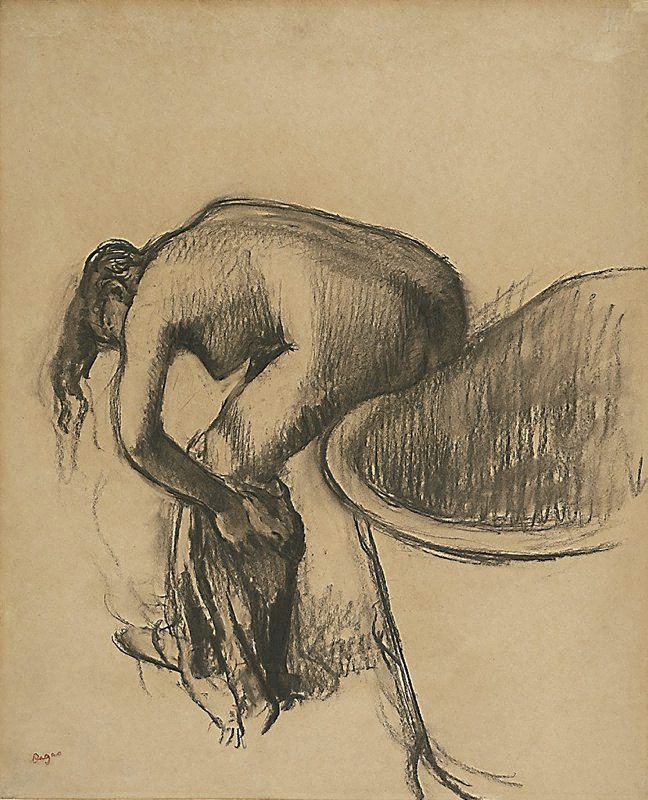
Degas was especially fascinated by the motif of the nude perched on the edge of a zinc bathtub, almost folded in on her own body, with her face concealed from the viewer. In the Gallery’s drawing, the model is observed bending forward and stretching her robust arm to dry her legs. The tension of her flattened back is relieved by her cascading hair and towel. By 1900 Degas was nearly blind, yet his vast experience as a draughtsman of the nude meant that his drawings now relied less on portraying what his eyes could see than on what his mind and hand instinctively knew to be true.
Peter Raissis, Prints & drawings Europe 1500–1900, 2014
-
Exhibition history
Shown in 12 exhibitions
Degas, Alex Reid & Lefevre, Ltd., London, 04 Jun 1970–04 Jul 1970
Degas, Fondation Pierre Gianadda, Martigny, 19 Jun 1993–21 Nov 1993
British and French paintings drawings and sculpture 1895 - 1993 from Browse and Darby, Robin Gibson Gallery, Darlinghurst, 04 Mar 1994–23 Mar 1994
Modernism 1900-1950: prints and drawings from the collection, Art Gallery of New South Wales, Sydney, 23 Jul 1994–25 Sep 1994
Great gifts, great patrons, Art Gallery of New South Wales, Sydney, 17 Aug 1994–19 Oct 1994
Body, Art Gallery of New South Wales, Sydney, 12 Sep 1997–16 Nov 1997
Michelangelo to Matisse: Drawing the figure, Art Gallery of New South Wales, Sydney, 20 Nov 1999–27 Feb 2000
Favourites: Margaret Olley and Jeffrey Smart (2002), S.H. Ervin Gallery, The Rocks, 12 Jan 2002–24 Feb 2002
Monet and the Impressionists, Art Gallery of New South Wales, Sydney, 11 Oct 2008–26 Jan 2009
Monet and the Impressionists, Museum of New Zealand Te Papa Tongarewa, Wellington, 14 Feb 2009–17 May 2009
European prints and drawings 1500-1900, Art Gallery of New South Wales, Sydney, 30 Aug 2014–02 Nov 2014
Degas: A New Vision, NGV: International, Melbourne, 24 Jun 2016–18 Sep 2016
Margaret Olley: a generous life, Queensland Art Gallery/Gallery of Modern Art, Brisbane, 15 Jun 2019–13 Oct 2019
-
Bibliography
Referenced in 17 publications
-
Art Gallery of New South Wales, Great gifts, great patrons: an exhibition celebrating private patronage of the Gallery, Sydney, 1994. no catalogue numbers
-
Anthony Bond, Body, 'Embodying the real', pp 11-80, Sydney, 1997, p 14, col illus p 130. figure 144, cat no 37
-
Peter Cochrane., The Sydney Morning Herald, 'The LOL who gave us all a $600,000 gift', Sydney, 28 May 1994, illus p 3.
-
Fondation Pierre Gianadda, Degas, Switzerland, 1993. cat no 83
-
Renée Free, Modernism 1900-1950: prints and drawings from the collection, Sydney, 1994, illus. no catalogue numbers
-
Renée Free, AGNSW Collections, 'The Western Heritage, Renaissance to Twentieth Century', pp 108-172, Sydney, 1994, col illus p 142, p 141.
-
Robert Gordon and Andrew Forge, Degas, London, 1988, p 244.
-
Charles Harrison, Painting the difference: sex and spectator in modern art, 2004, illus.
-
Bruce James, Art Gallery of New South Wales handbook, 'Western Collection: Works on Paper', pp 78-92, Sydney, 1999, illus p 85.
-
Terence Maloon and Peter Raissis (Editors), Michelangelo to Matisse: drawing the figure, Sydney, 1999, col illus p 183. cat no 175
-
Terence Maloon, Look, 'Of Gods and Men: Drawing the figure', pp 8-11, Melbourne, Nov 1999, col illus p 11.
-
Margaret Olley and Jeffrey Smart, Favourites: Margaret Olley and Jeffrey Smart selections, Sydney, 2002. NOTE: No catalogue numbers; Margaret Olley selection.
-
Chiara O'Reilly, Journal of the history of collections, vol 32, no 2, 'Collecting French art in the late 1800s at the Art Gallery of New South Wales', Jul 2020, pp 313–25: p 323.
-
Peter Raissis, Prints & drawings Europe 1500-1900, Sydney, 2014, p 188, col illus 189.
-
Robin Gibson Gallery, British and French Paintings Drawings & Sculpture 1895 - 1993 from Browse & Darby, Sydney, 1994, illus. cat no 1
-
Denys Sutton, Degas, England, 1970, p 60, illus p 61. cat no 20, This record is entered as 'Femme nue s'essuyant'.
-
Frank Walker, Herald Sun, 'What lies beneath 95% of gallery's art collection hidden in basement', p 18, Port Melbourne, 30 Dec 2007, p 18.
-

