-
Details
- Other Title
- Heng Fei
- Place where the work was made
-
Yunnan Province
→
China
- Cultural origin
- Mian
- Date
- circa 1850s
- Media category
- Painting
- Materials used
- pigment on paper
- Dimensions
- 118.5 x 49.3 cm
- Credit
- Gift of Dr John Yu and Dr George Soutter 2006
- Location
- Not on display
- Accession number
- 269.2006
- Copyright
- Artist information
-
Yao people
Works in the collection
- Share
-


-
About
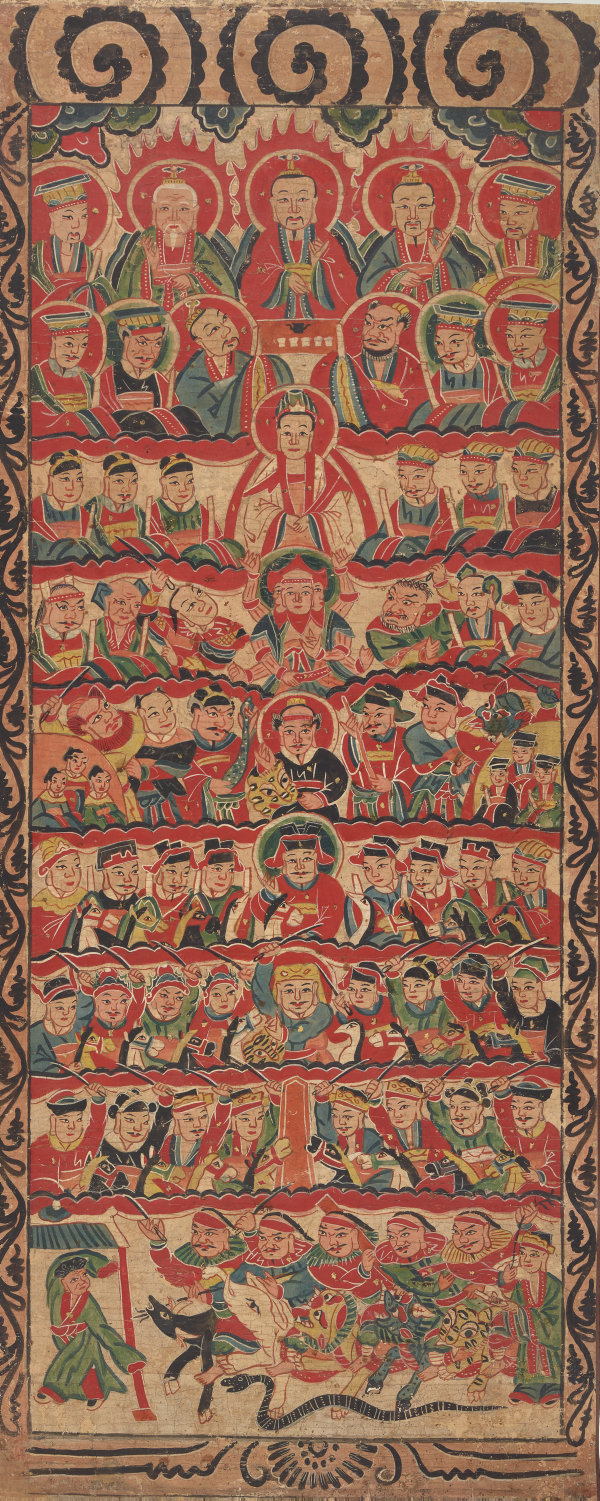
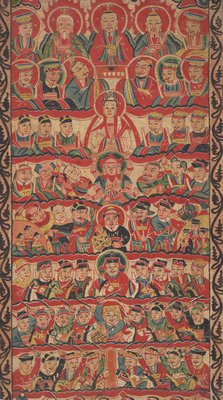
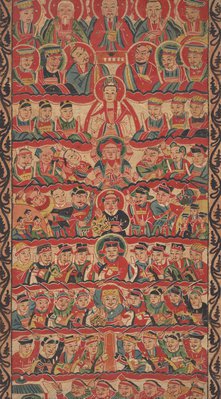
Hangsi means the 'Full Altar' or the 'Administration' and is a depiction of the whole Daoist pantheon. Strongly influenced by Chinese tradition, this painting shows a group of Daoist gods and celestial worthies whom the Yao view as a 'Cosmic Fraternity' that was considered to have control of the whole universe. Some Buddhist influence is evident with the inclusion of Guanyin.
The Daoist pantheon depicted includes:
Top row: The 3 Pure ones in the middle l to r: Daode, Yuanshi, Lingbao, flanked by the Jade Emperor (r) and the Master of Saints(l)
Second Row: believed to be attendants of the Jade Emperor and the Master of Saints
Third row: in the middle the Buddhist Bodhisattva Guanyin
Fourth Row: the middle 3 headed deity with many arms is thought to be the Buddhist Goddess of Light Marichi, whom the Yao have appropriated as Tai Sui, God of the Year.
Fifth row: the 6 Marshals; the 3 matrons of Daoist religion in a circle.
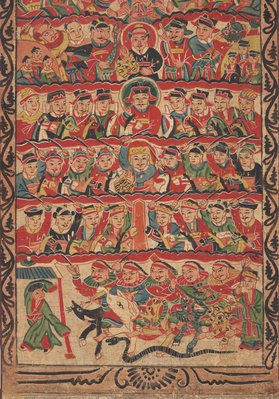
Sixth row: Haifan (The Sea Banner) and his horsemen
Seventh row: Taiwei (The High Constable) with horsemen
Eighth row: At middle a ritual furnace to burn paper money for the ‘Celestial Treasuries’; offerings (smoke) reaching the top
Ninth row: Five orderlies mounted from l to r, on a buffalo, white elephant, lion, unicorn and tiger; left is the God of SoilReference: Jacques Lemoine, 'Yao Ceremonial Paintings', 1982.
Asian Art Department, AGNSW, 2007.
-
Places
Where the work was made
Yunnan Province
-
Exhibition history
Shown in 1 exhibition
Walking with gods, Art Gallery of New South Wales, Sydney, 01 Jun 2019–05 Jan 2020
-
Provenance
John Yu, 1980s-2006, Sydney/New South Wales/Australia, the nine Yao ceremonial paintings donated by Dr John Yu were purchased from different locations including Xian in Shaanxi province of China, Bangkok, Shanghai and Hong Kong.