Title
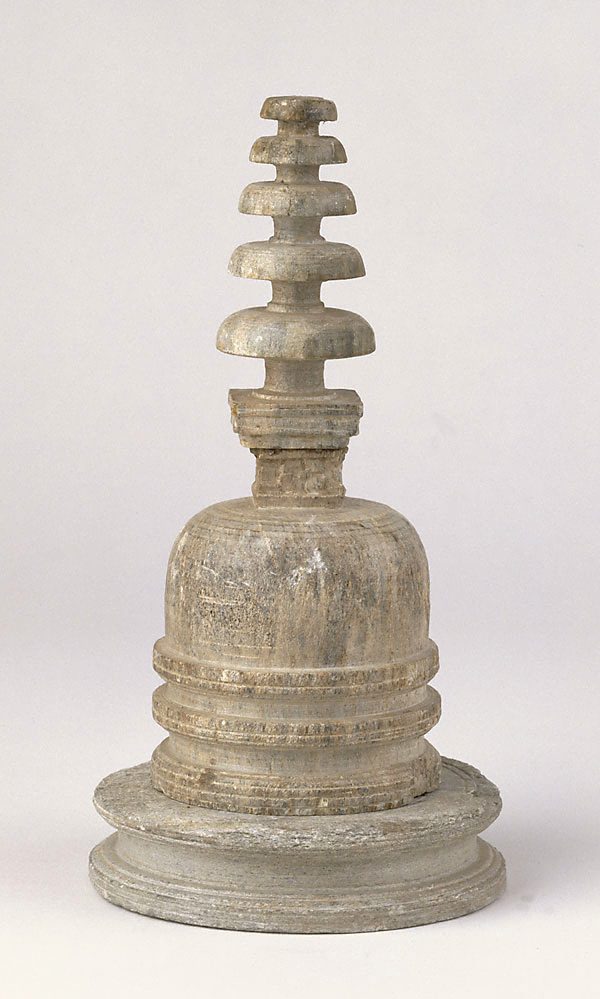
Votive stupa with base
1st century
Artists
Unknown Artist
-
Details
- Place where the work was made
-
Ancient Gandhara
→
Pakistan
- Period
- Kushan period mid 1st century - early 5th century
- Date
- 1st century
- Media category
- Sculpture
- Materials used
- marble
- Dimensions
-
23.0 x 11.9 cm overall
:
a - lid, 20 x 8.3 cm
b - base, 3.1 x 11.9 cm
- Signature & date
Not signed. Not dated.
- Credit
- Bequest of Alex Biancardi 2000
- Location
- Not on display
- Accession number
- 27.2000.a-b
- Copyright
- Share
-


-
About
The stupa is probably the most revered symbol in Buddhism. Its shape is based on the memorial mound raised over the mortal remains of the Buddha Shakyamuni. For the early Buddhists, the stupa was a symbol both of the Buddha's Parinirvana (extinction) and of the faith itself. Images of the stupa abound in Buddhist art, in media as diverse as stone, bronze, crystal and gold. This formally proportioned stupa is typical in construction: a base, a hemispherical body surmounted by a 'harmika' (a square structure derived from the fenced enclosures of early shrines), and crowned by a multi-tiered umbrella.
The Asian Collections, AGNSW, 2003, pg.26.
-
Bibliography
Referenced in 1 publication
-
Jackie Menzies (Editor), The Asian Collections Art Gallery of New South Wales, 'Buddhist Art', Sydney, 2003, 26 (colour illus.).
-