
-
Details
- Other Title
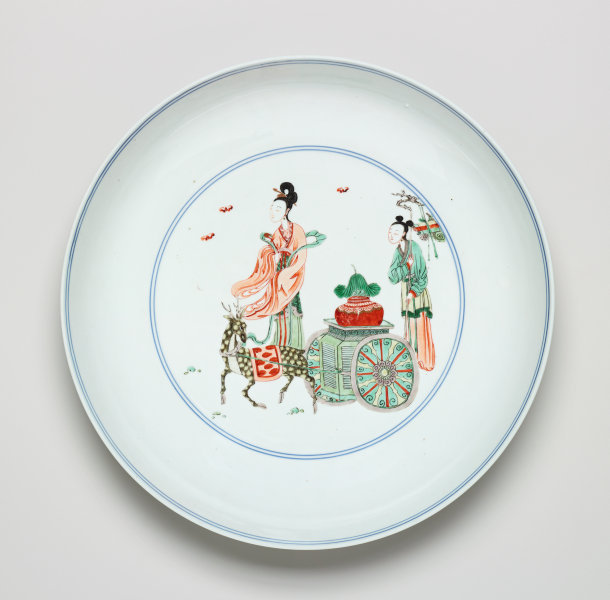
- Large dish decorated with design of Xi Wangmu
- Place where the work was made
-
Jingdezhen
→
Jiangxi Province
→
China
- Period
- Kangxi 1662 - 1722 → Qing dynasty 1644 - 1911 → China
- Date
- early 18th century
- Media category
- Ceramic
- Materials used
- porcelain with 'famille verte' decoration
- Dimensions
- 7.2 x 39.6 cm
- Credit
- Gift of Mr J.H. Myrtle on the occasion of the opening of the new Asian Gallery 1987
- Location
- Not on display
- Accession number
- 435.1987
- Copyright
- Artist information
-
Jingdezhen ware
Works in the collection
- Share
-


-
About
The best porcelain of the Kangxi period has pure white body, smooth clear glazes and skilfully applied, sophisticated decoration. Apart from blue and white, the main porcelain product of the period was 'famille verte', a term coined in the middle of the nineteenth century by the French ceramic collector, Albert Jacquemart to refer to the large group of ceramics in which the prevailing colour within the over-glaze enamel repertoire was green. The auspicious imagery on this fine example of 'famille verte' porcelain is from Daoist philosophy. Xi Wangmu, Queen Mother of the Western paradise, where the peaches of longevity grow, is depicted accompanied by an attendant. A spotted deer (symbol of longevity) draws a cart carrying an elixir. Bats, symbols of happiness, reinforce the good wishes, while the reverse of the dish is decorated with 100 archaic Daoist variations of the character 'shou' (longevity).
'Asian Art', AGNSW Collections, 1994. pg. 203.
-
Places
Where the work was made
Jingdezhen
-
Exhibition history
Shown in 3 exhibitions
Chinese Ceramics, Art Gallery of New South Wales, Sydney, 11 Aug 1965–12 Sep 1965
Chinese porcelain of the Ming and Ch'ing dynasties, Art Gallery of New South Wales, Sydney, 18 Feb 1977–26 Jun 1977
Great gifts, great patrons, Art Gallery of New South Wales, Sydney, 17 Aug 1994–19 Oct 1994
-
Bibliography
Referenced in 7 publications
-
Mr V V W Fretwell, Mr L G Harrison, Ivan McMeekin and J. Hepburn Myrtle (Compilators), Chinese ceramics, Sydney, 1965, 28, 42 (iilus.). cat.no. 118, plate no. 24
-
J. Hepburn Myrtle, Chinese porcelain of the Ming and Ch'ing dynasties, Sydney, 1977, 27. cat.no. 45
-
Jackie Menzies, AGNSW Collections, 'Asian Art - India, South-East Asia, China, Tibet, Korea, Japan', pg. 173-228, Sydney, 1994, 203 (colour illus.).
-
Jackie Menzies (Editor), The Asian Collections Art Gallery of New South Wales, 'The Marvel of Porcelain', Sydney, 2003, 124 (colour illus.).
-
Jackie Menzies, Look, 'Porcelain power', pg. 30-31, Sydney, Feb 2009, 30 (colour illus.), 31 (colour illus.). image on page 30 is the front and image on page 31 is the back.
-
Jacqueline Menzies, Art Gallery of New South Wales handbook, 'Asian', pg. 72-93, Sydney, 1988, 76 (illus.).
-
Julian Thompson, Orientations, 'Chinese Porcelain in the Collection of the Art Gallery of New South Wales', pg. 96-103, Hong Kong, Sep 2000, 102 (illus.; colour illus.). fig.11 and 11a (mark)
-


