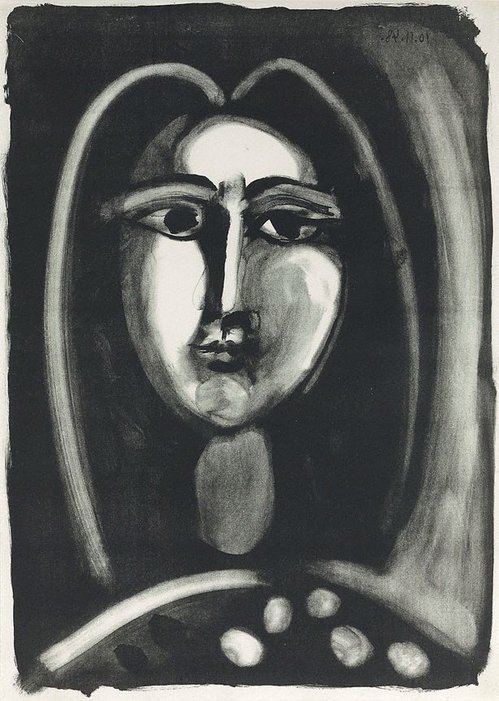
-
Details
- Other Titles
- Still life with fruit dish
Nature morte au compotier - Alternative title
- Nature morte, compotier
- Date
- 1909
- Media category
- Materials used
- drypoint
- Edition
- iii of 3 states. From an edition of 100
- Dimensions
- 13.0 x 11.0 cm image; 38.0 x 30.3 cm sheet
- Signature & date
Signed l.r. sheet, pencil "Picasso". Not dated.
- Credit
- Purchased 1986
- Location
- Not on display
- Accession number
- 60.1986
- Copyright
- © Pablo Picasso/Succession Pablo Picasso. Copyright Agency
- Artist information
-
Pablo Picasso
Works in the collection
- Share
-


-
About
Drypoint, involving as it does the direct marking of the metal plate with an engraving tool, requires of the artist the utmost concentration and control; it is not a technique for the indecisive. Picasso was especially adept at this difficult medium. Some of his earliest prints are drypoints, or etchings with drypoint inclusions. This example of the former is from the high point of his early cubist phase, during which he and Braque had established the spatial fundamentals of the style. Like certain paintings of the same year, this still life takes its time-honoured genre into an entirely new category. The term 'analytical cubism' has been applied to the style, indicating the quasi-scientific arena of reality that Picasso and Braque were so keen to explore. Like an aftershock, a wave of energy rolls across the composition, dislodging every object from its axis. At the same time an extraordinary sense of order, which we may call cubist harmonics, stabilises the scene. In the draperies, bowls, and most of all the talismanic pears, Picasso pays obvious homage to his predecessor, Cezanne.
Art Gallery Handbook, 1999.
-
Exhibition history
Shown in 6 exhibitions
Five years on: a selection of acquisitions 1981-1986, Art Gallery of New South Wales, Sydney, 26 Sep 1986–23 Nov 1986
Picasso Before Nature, Auckland Art Gallery Toi o Tamaki, Auckland, 22 Sep 1989–12 Nov 1989
Modernism 1900-1950: prints and drawings from the collection, Art Gallery of New South Wales, Sydney, 23 Jul 1994–25 Sep 1994
Paths to abstraction 1867-1917, Art Gallery of New South Wales, Sydney, 26 Jun 2010–19 Sep 2010
Modernists: selections from the European collection, Art Gallery of New South Wales, Sydney, 07 Nov 2015–25 Apr 2016
Matisse Alive, Art Gallery of New South Wales, Sydney, 11 Oct 2021–03 Apr 2022
-
Bibliography
Referenced in 7 publications
-
Art Gallery of New South Wales, Five years on: a selection of acquisitions 1981-1986, Sydney, 1986. cat.no. 197
-
Stephen Coppel, Picasso and Printmaking in Paris, 'Cubist etchings', London, 1998, 13-14.
-
Renée Free, AGNSW Collections, 'The Western Heritage, Renaissance to Twentieth Century', pg. 108-172, Sydney, 1994, 144 (colour illus.).
-
Renée Free, Modernism 1900-1950: prints and drawings from the collection, Sydney, 1994. no catalogue numbers
-
Bernhard Geiser and Brigitte Baer, Picasso peintre-graveur. Tome I. Catalogue raisonné de l'oeuvre gravé et lithographié et des monotypes 1899-1931, 1990, pp 55–56, no 22, illus p 56.
-
Bruce James, Art Gallery of New South Wales handbook, 'Western Collection: Works on Paper', pg. 78-92, Sydney, 1999, 86 (illus.).
-
Terence Maloon, Paths to abstraction 1867-1917, Sydney, 2010, 212 (illus.).
-