Title
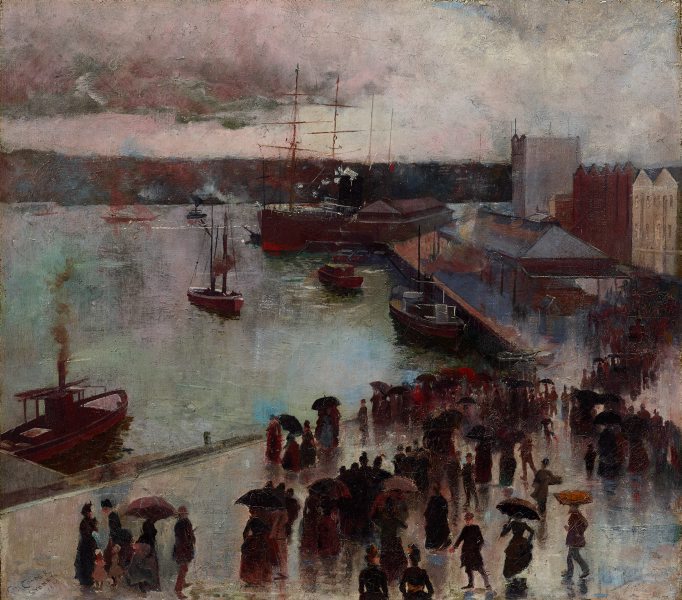
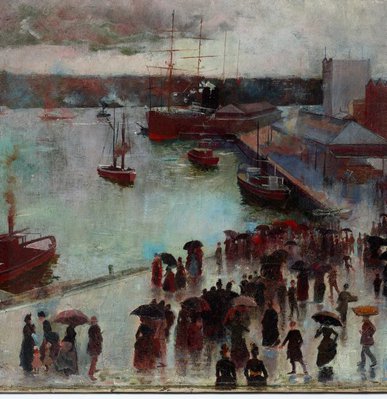
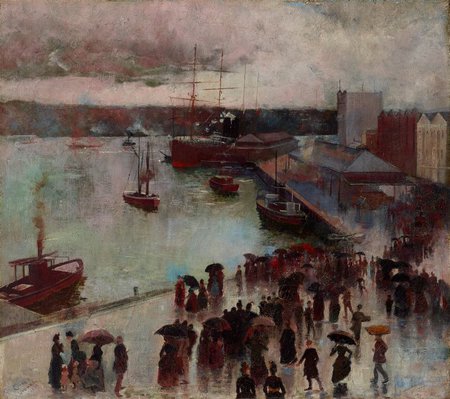
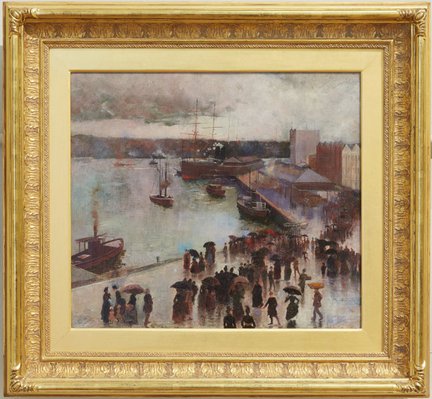
Departure of the Orient - Circular Quay
1888
Artist
-
Details
- Other Titles
- Departure of S.S. "Orient" from Circular Quay, Sydney
Departure of the 'Orient'
The Departure of Orient Steamer
Departure of S.S. Orient
Departure of SS. Orient
Departure of S.S. "Orient" from Circular Quay, Sydney
Departure of the S.S. Orient
Departure of the s.s. Orient - Circular Quay
Departure of the 'Orient' - Circular Quay - Place where the work was made
-
Sydney
→
New South Wales
→
Australia
- Date
- 1888
- Media category
- Painting
- Materials used
- oil on canvas
- Dimensions
- 45.1 x 50.1 cm stretcher; 67.0 x 72.0 x 7.8 cm frame
- Signature & date
Signed and dated l.l. corner, incised "CHAS CONDER/ SYDNEY/ 1888".
Signed and dated l.l. corner, red oil "CHAS CONDER/ SYDNEY/ 1888".- Credit
- Purchased 1888
- Location
- South Building, ground level, Grand Courts
- Accession number
- 829
- Copyright
- Artist information
-
 Charles Conder
Works in the collection
- Share
-


-
About
Arriving in Australia as an adolescent in 1884, Charles Conder became one of the key founders of the Heidelberg school of Australian impressionism. He returned to Europe six years later to become a legendary figure of the fin de siècle, mixing with leading artists and writers including Henri de Toulouse-Lautrec and Oscar Wilde.
Exhibited in Sydney in 1888, 'Departure of the Orient – Circular Quay' was Conder’s impressive artistic debut. With its silvery-grey tonality, contrasted with touches of brilliant colour, the work reflects the influence of Whistler and the principles of Aesthetic painting. Conder’s interest in Japanese art – or Whistler-inspired Japonisme – with its large, empty spaces, is also paramount.
-
Places
Where the work was made
Sydney
-
Exhibition history
Shown in 24 exhibitions
Ninth Annual Exhibition of the Art Society of New South Wales (1888), Society Rooms, Union Chambers, Sydney, 17 Sep 1888 -
World's Columbian Exposition, 1893, Jackson Park, Chicago, , 01 May 1893–30 Oct 1893
Exhibition of Australian art in London (1898), Grafton Galleries, London, 02 Apr 1898–31 Jul 1898
Fifty years of Australian art, 1879-1929 by members of Royal Art Society, with a commentary by George Galway, Blaxland Gallery, Sydney, 25 Nov 1929–07 Dec 1929
150 years of Australian art (1938), National Art Gallery of New South Wales, Sydney, 27 Jan 1938–25 Apr 1938
Art of Australia 1788-1941, National Gallery of Art, Washington D.C., 01 Oct 1941–26 Oct 1941
Art of Australia 1788-1941, The Metropolitan Museum of Art, New York, 17 Nov 1941–31 Dec 1941
Art of Australia 1788-1941, Yale University Art Gallery, United States of America, 02 Mar 1942–23 Mar 1942
Art of Australia 1788-1941, Carnegie Institute, Pittsburgh, 03 Apr 1942–15 May 1942
Art of Australia 1788-1941, Wilmington Society of Fine Arts, Wilmington, 01 Jun 1942–27 Jun 1942
Art of Australia 1788-1941, Los Angeles County Museum of Art, Los Angeles, 10 Jul 1942–27 Aug 1942
Art of Australia 1788-1941, Toledo Museum of Art, United States of America, 06 Sep 1942–27 Sep 1942
Art of Australia 1788-1941, Rochester Memorial Art Gallery, Rochester, 05 Oct 1942–02 Nov 1942
Art of Australia 1788-1941, Cleveland Museum of Art, United States of America, 09 Nov 1942–07 Dec 1942
Art of Australia 1788-1941, Detroit Institiute of Arts, Detroit, 01 Jan 1943–29 Jan 1943
Art of Australia 1788-1941, Herron Museum of Art, Indianapolis, Indianapolis, 08 Apr 1943–05 May 1943
Art of Australia 1788-1941, Fort Wayne Art School and Museum, Fort Wayne, 12 May 1943–31 May 1943
Art of Australia 1788-1941, Rockhill Nelson Gallery, Kansas City, 07 Sep 1943–08 Oct 1943
Art of Australia 1788-1941, Philbrook Art Museum, Tulsa, 20 Oct 1943–17 Nov 1943
Art of Australia 1788-1941, Museum of Fine Arts, Dallas, Dallas, 28 Nov 1943–26 Dec 1943
Art of Australia 1788-1941, Abilene Museum of Fine Arts, Abilene, 10 Jan 1944–07 Feb 1944
Art of Australia 1788-1941, Heard Museum, Phoenix Fine Arts Association, Phoenix, 21 Feb 1944–20 Mar 1944
Art of Australia 1788-1941, San Francisco Museum of Art, San Francisco, 04 Apr 1944–07 May 1944
Art of Australia 1788-1941, Rosicrucian Egyptian Oriental Museum, San Jose, 19 May 1944–16 Jun 1944
Art of Australia 1788-1941, Hamline University, St Paul, 01 Dec 1944–17 Dec 1944
Art of Australia 1788-1941, Society Liberal Arts, Joslyn Memorial, Omaha, 06 Jan 1945–27 Jan 1945
Art of Australia 1788-1941, Munson-Williams-Proctor Institute, United States of America, 06 Feb 1945–27 Feb 1945
Art of Australia 1788-1941, Quincy Art Club, Quincy, 09 Mar 1945–30 Mar 1945
Art of Australia 1788-1941, Oklahoma Art Center, Oklahoma City, 13 Apr 1945–04 May 1945
Art of Australia 1788-1941, University of Oklahoma, Norman, 14 May 1945–04 Jun 1945
Art of Australia 1788-1941, North Texas State Teachers' College, Denton, 14 Jun 1945–05 Jul 1945
100 years of Australian painting (1948), Art Gallery of New South Wales, Sydney, 19 Apr 1948–17 May 1948
Jubilee exhibition of Australian art, Tasmanian Museum and Art Gallery, Hobart, 12 Mar 1951–31 Mar 1951
Jubilee exhibition of Australian art, Queen Victoria Museum and Art Gallery, Launceston, Launceston, 09 Apr 1951–28 Apr 1951
Jubilee exhibition of Australian art, Art Gallery of New South Wales, Sydney, 25 Jun 1951–21 Jul 1951
Jubilee exhibition of Australian art, Queensland Art Gallery, South Brisbane, 06 Aug 1951–01 Sep 1951
Jubilee exhibition of Australian art, Art Gallery of South Australia, Adelaide, 24 Sep 1951–20 Oct 1951
Jubilee exhibition of Australian art, Art Gallery of Western Australia, Perth, 12 Nov 1951–10 Dec 1951
A retrospective exhibition of Australian painting, Art Gallery of New South Wales, Sydney, 25 Sep 1953–25 Oct 1953
The Arts Festival of the Olympic Games (1956), National Gallery of Victoria [Swanston Street], Melbourne, 18 Nov 1956–15 Dec 1956
Australian Painting: Colonial, Impressionist, Contemporary (1962-63), National Gallery of South Australia, Adelaide, 17 Mar 1962–31 Mar 1962
Australian Painting: Colonial, Impressionist, Contemporary (1962-63), Art Gallery of Western Australia, Perth, 23 Sep 1962–24 Oct 1962
Australian Painting: Colonial, Impressionist, Contemporary (1962-63), Tate Britain, England, 24 Jan 1963–03 Mar 1963
Sydney Harbour: an exhibition to mark the 175th anniversary of the founding of Australia (1963), Art Gallery of New South Wales, Sydney, 30 Oct 1963–19 Nov 1963
Charles Conder: 1868-1909 (1966), National Gallery of Victoria [Swanston Street], Melbourne, 09 Aug 1966–04 Sep 1966
Charles Conder: 1868-1909 (1966), Art Gallery of New South Wales, Sydney, 09 Nov 1966–04 Dec 1966
Golden Summers - Heidelberg and beyond, National Gallery of Victoria [St Kilda Road], Melbourne, 30 Oct 1985–27 Jan 1986
Golden Summers - Heidelberg and beyond, Art Gallery of New South Wales, Sydney, 21 Feb 1986–20 Apr 1986
Golden Summers - Heidelberg and beyond, Art Gallery of South Australia, Adelaide, 09 May 1986–29 Jun 1986
Golden Summers - Heidelberg and beyond, Art Gallery of Western Australia, Perth, 30 Jul 1986–14 Sep 1986
Bohemians in the bush: the artists' camps of Mosman, Art Gallery of New South Wales, Sydney, 06 Jun 1991–25 Aug 1991
Two hundred years of Australian painting : Nature, people and art in the southern continent, National Museum of Western Art, Tokyo, Japan, 28 Apr 1992–28 Jun 1992
Two hundred years of Australian painting : Nature, people and art in the southern continent, The National Museum of Modern Art, Kyoto, Kyoto, 14 Jul 1992–06 Sep 1992
Charles Conder retrospective (2003-2004), Art Gallery of New South Wales, Sydney, 14 Jun 2003–17 Aug 2003
Charles Conder retrospective (2003-2004), Ian Potter Centre: NGV Australia, Melbourne, 05 Sep 2003–09 Nov 2003
Charles Conder retrospective (2003-2004), Art Gallery of South Australia, Adelaide, 21 Nov 2003–26 Jan 2004
Exiles and emigrants: Epic journeys to Australia in the Victorian era, Ian Potter Centre: NGV Australia, Melbourne, 09 Dec 2005–26 Mar 2006
Exiles and emigrants: Epic journeys to Australia in the Victorian era, National Museum of Australia, Canberra, Canberra, 21 Apr 2006–04 Jun 2006
Australian Impressionism, Ian Potter Centre: NGV Australia, Melbourne, 31 Mar 2007–08 Jul 2007
American Impressionism and Realism: a landmark exhibition from the Met, Queensland Art Gallery, South Brisbane, 30 May 2009–20 Sep 2009
Australia, Royal Academy of Arts, London, 21 Sep 2013–08 Dec 2013
Australia's Impressionists, National Gallery, London, London, 07 Dec 2016–26 Mar 2017
A Nation Imagined: The Artists of the Picturesque Atlas, National Library of Australia, Canberra, 12 Mar 2021–11 Jul 2021
Grand Courts collection rehang, Art Gallery of New South Wales, Sydney, Nov 2021–2023
-
Bibliography
Referenced in 80 publications
-
Art Gallery of New South Wales, Art Gallery of New South Wales picturebook, Sydney, 1972, 80 (colour illus.). titled 'Departure of the s.s. Orient - Circular Quay'
-
Leigh Astbury, Meridian, 'Poetic impulses in Australian landscape painting: the Heidelberg school reconsidered', pg. 123 - 141., Bundoora, Oct 1985, 129.
-
Leigh Astbury, Sunlight and shadow: Australian impressionist painters 1880-1900, Rushcutters Bay, 1989, 24 (colour illus., detail), 37 (colour illus.), 223. plate no. 22; titled 'Departure of the Orient - Circular Quay'
-
Herbert Badham, A study of Australian art, Sydney, 1949, 2 (colour illus.), 53.
-
Herbert Badham, A gallery of Australian art, 'Introduction', pg. v-vii., Sydney, 1954, xi, xv, (colour illus.). plate no. 14
-
Christine Bates, Making art connections: Visual arts years 7 & 8, 'Lets make an artwork: Peeking into private worlds', pg. 38-39, North Ryde, 2010, 38 (colour illus.).
-
Okko Boer, Masters of the Heidelberg School, 'Charles Conder: the 'emigre' participant', pg. 45-57, Leichhardt, 1998, 48 (illus.), 49. plate no. 45; titled 'Departure of the S.S. Orient - Circular Quay'
-
Tim Bonyhady, Australia's impressionists, 'The sunny south', pg. 19-30, London, 2016, 20 ,74 (colour illus.), 113, 124, 126. cat.no. 11
-
Maurice Brodzky (Editor), Table talk, Melbourne, 05 Oct 1888, 4.
-
Edmund Capon AM, OBE, Art Gallery of New South Wales: highlights from the collection, Sydney, 2008, 58 (colour illus.), 59.
-
Bonny Cassidy., Tertangala, 'Charles Conder: a retrospective 1868-1909', Wollongong, Aug 2003, (illus.). Exhibition review.
-
Jane Clark and Bridget Whitelaw, Golden summers: Heidelberg and beyond, Melbourne, 1985, 94 (colour illus.). titled 'Departure of the Orient - Circular Quay'
-
Betty Currie, Girolamo Pieri Nerli (1863-1926), Melbourne, 1976, 19, 24, 26, 27, 29, 33, (illus.).
-
Michael Dunn, Nerli: an Italian painter in the South Pacific, 'Nerli's paintings', pg. 18-54, Auckland, 2005, 25, 26 (illus.), 27. figure no. 12
-
Mary Eagle, Australian Impressionism, 'Friendly rivalry: paintings of waterside Sydney, 1888 and 1890', pg. 103-108, Melbourne, 2007, 321, 104, 106-108, 79, 113 (colour illus.), 107 (colour illus. detail). cat.no. 6.3
-
Peter Entwisle, Nerli - An exhibition of paintings & drawings, 'G.P. Nerli: Influences in Australia', pg. 28-38, Dunedin, 1988, 21 (illus.), 28, 32, 34, 36.
-
Brian Finemore, Painting, 'Introduction', pg. 4-5, London, 1961, 4, 13 (illus.). This work is titled "Departure of the S.S. Orient".
-
Ann Galbally, Craft arts international, 'Charles Conder 1868-1909', pg. 81-83, Sydney, 2003, 83 (colour illus.).
-
Ann Galbally, Charles Conder: the last bohemian, 'A child of Empire', pg. 5-28, Melbourne, 2002, xi, 26-28, following 46 (colour illus.), 191. titled 'Departure of the Orient - Circular Quay'
-
George Galway, Fifty years of Australian art 1879-1929, New South Wales, 1929, 59 (illus.). titled 'The Departure of Orient Steamer'
-
Frank Gibson and Campbell Dodgson, Charles Conder: his life and work, London, 1914, 29, 108. titled 'Departure of SS. "Orient"'
-
James Gleeson, Masterpieces of Australian painting, Melbourne, 1969, 66, 67 (colour illus.). plate no. 18
-
Grafton Galleries, Exhibition of Australian art in London, London, 1898, 49. cat.no. 311; titled 'Departure of the "Orient"'; lent by the Trustees of Sydney Gallery; NOTE: Artist is 'Chas. Conder'.
-
Anne Gray, Australia, 'Art nation: Australian landscape 1880-1920', pg. 146-183, London, 2013, 153, 160 (colour illus.). cat.no. 99
-
Sasha Grishin, Australian art: a history, 'In search of an Australian identity', pg. 116-127, Carlton, 2013, 125, 126 (colour illus.), 127, 548, 558. plate no. 13.8
-
Sasha Grishin., The Canberra times, 'Spirit of brilliance', Ainslie, 22 Jun 2003. Exhibition review.
-
Kerry Heckenberg, Queensland Review (vol.15, no.1), 'JJ. Hilder and the Languages of Art', pg. 33-49, Queensland, 2008, 35.
-
Dr Ursula Hoff, Charles Conder - his Australian years, Melbourne, 1960, 7, 12-13, 17-18, 20, 25, 31 (colour illus.). plate no. 6; cat.no. 10; titled 'Departure of the Steamship Orient' on pg. 25; titled 'Departure of the S.S. Orient' on pg. 31.
-
Dr Ursula Hoff, Charles Conder, Melbourne, 1972, 21-24, 100, plate no. 8 (colour illus.). plate no. 8; cat.no. C20; titled 'Departure of the S.S. Orient, Circular Quay'
-
Dr Ursula Hoff, Charles Conder: 1868-1909, Sydney, 1966. cat.no. 8; titled 'Departure of the steamship Orient'; not paginated; NOTE: in the introduction title is refered to as 'Departure of the S.S. Orient'
-
Martin Hopkinson, The British art journal [vol. V, no. 2], 'Charles Conder 1868-1909 by Ann Galbally and Barry Pearce', pg. 98-99, London, 2004, 98. NOTE: Book review.
-
Robert Hughes, The art of Australia, 'The Heidelberg School 1885-96', pg. 53-73, Melbourne, 1970, 12, 70 (illus.), 72. plate no. 23; titled 'The Departure of S.S. Orient'
-
Victoria Hynes, The Sydney Morning Herald, 'Exhibitions', pg. 27, Sydney, 13 Jun 2003, 27 (colour illus.). Exhibition review in Metro Supplement
-
Bruce James, Art Gallery of New South Wales handbook, 'Australian Collection: Painting and Sculpture', pg. 102-181, Sydney, 1999, 111 (colour illus.). titled 'Departure of the Orient, Circular Quay'
-
Patrick Jourdan, John-Peter Russell, un impressionniste australien : dans les collections françaises, autour du dépôt au Musée de Morlaix du legs Jouve, Musée du Louvre - fonds Orsay, Morlaix, 1997, 15.
-
Robyn Krause-Hale and Ruth Pullin, Conder & friends, 'The painting of modern life', Melbourne, 2003, (colour illus.), (colour illus., detail).
-
Brian Ladd, The Artist & the City, 'Introduction', pg. 4-5, Sydney, 1983, 4. titled 'Departure of S.S. Orient'
-
Jean-Claude Lesage, Peintres Australiens à Etaples, 'Les Picardistes', pg. 14-26, Étaples-sur-Mer, 2000, 15, 16 (colour illus.).
-
Lionel Lindsay, 150 years of Australian art, Sydney, 1938, (illus.). cat.no. 156; not paginated
-
Patricia Macdonald, Exiles and emigrants: epic journies to Australia in the Victorian era, Melbourne, 2005, 99 (colour illus.), 137.
-
Patrick McCaughey, Encounters with Australian modern art, 'Affinity and antinomy in Australian painting 1960-1985', pg. 79-178, South Yarra, 2008, 89.
-
Ewen McDonald, AGNSW Collections, 'From Colonialism to late Modernism', pg. 7-106, Sydney, 1994, 14 (colour illus.). titled 'Departure of the Orient - Circular Quay'
-
John McDonald, Art of Australia. Vol 1: Exploration to Federation, 'Our hill of gold', pg. 419-484, Sydney, 2008, 443, 444 (colour illus.), 576.
-
Denise Mimmocchi, Australian Symbolism: the art of dreams, ‘Dreams of the bohemian idyll: Charles Conder and his impact’, pg. 90-110, Sydney, 2012, 90-91.
-
Hal Missingham, A retrospective exhibition of Australian painting, Section 3, Sydney, 1953, not paginated. cat.no. 43; titled 'Departure of the S.S. Orient'
-
William Moore, The story of Australian art from the earliest known art of the continent to the art of today (Vol. 1), Sydney, 1934, opposite 91 (illus.).
-
Les Moseley, Look, 'From the Society president', pg. 9, Sydney, Aug 2015, 9.
-
National Art Gallery of New South Wales, Catalogue of the National Art Gallery of New South Wales 1893, Sydney, 1893, 107. cat.no. 370; titled 'Departure of the 'Orient''
-
Olympic Civic Committee of Melbourne City Council, The arts festival of the Olympic Games, Melbourne: a guide to the exhibitions with introductory commentaries on the arts in Australia, Melbourne, 1956, 82. cat.no. 16; titled 'Departure of the S.S. "Orient"'
-
Barry Pearce, Look: 1953-2003 celebrating 50 years, 'The enigmatic Charles Conder: spotlight on a lesser known Heidelberg painter', pg. 8-11, Sydney, May 2003, 10 (colour illus.). titled 'Departure of the Orient - Circular Quay'
-
Barry Pearce and Haruo Arikawa, Two hundred years of Australian painting: nature, people and art in the southern continent, Tokyo, 1992, 94 (colour illus.). cat.no. 49; titled 'Departure of the Orient - Circular Quay'; NOTE: See also unpublished translation of catalogue for entry.
-
Albie Thoms, Bohemians in the bush: the artists' camps of Mosman, Sydney, 1991, 45, 76. cat.no. 13; titled 'Departure of the S.S. Orient, Circular Quay'
-
Barry Pearce, Australian art: in the Art Gallery of New South Wales, 'Introduction', pg. 10-16, Sydney, 2000, 12, 38, 53 (colour illus.), 300. titled 'Departure of the Orient - Circular Quay'
-
Barry Pearce, Charles Conder 1868-1909, 'Between worlds: Conder in Australia', pg. 12-31, Sydney, 2003, 21, 47, 62, 63 (colour illus., detail), 84, 85 (colour illus.), 181, 192, 198, 199. cat.no. 16; titled 'Departure of the Orient - Circular Quay'
-
Barry Pearce., Australian artist, 'Charles Conder: lost and found voice of the Heidelberg School', Chatswood, Jun 2003, (colour illus.).
-
Barry Pearce, The Weekend Australian, 'Forgotten impressionist', pg. 16-17, Sydney, 07 Jun 2003-08 Jun 2003, 17 (colour illus.).
-
Barry Pearce, Art Gallery of New South Wales handbook, 'Australian', pg. 13-35, Sydney, 1988, 17 (illus.). titled 'Departure of the Orient - Circular Quay'
-
Public Programmes Department, Art Gallery of New South Wales, 'K' is for Conder: Charles Conder retrospective, Sydney, 2003, (illus.). not paginated
-
Sir John Rothenstein, The life and death of Conder, London, 1938, 9, 30, 37, 285. titled 'Departure of S.S. "Orient" from Circular Quay, Sydney'
-
Lynne Seear, American Impressionism & Realism: A landmark exhibition from The Met, 'Continental drift: Stories from Australia about an American exhibition', pg. 51-61, Sydney, 2009, 60 (colour illus.), 92 (colour illus., detail), 93, 96, 97 (colour illus.), 316, 330. cat.no. 2A; Exhibited in the 'Cities Australia' section
-
Bernard Smith, 100 years of Australian painting, 'Foreword', pg. 2-4, Sydney, 1948, 5. cat.no. 6; titled 'The Departure of S.S. Orient'
-
Bernard William Smith, A catalogue of Australian oil paintings in the National Art Gallery of New South Wales 1875-1952, Sydney, 1953, 50. cat.no. 127; titled 'Departure of the S.S. Orient'
-
Bernard William Smith, Place, taste and tradition: a study of Australian art since 1788, 'Impressionism in Australia', pg. 112-145, South Melbourne, 1979, 122 (illus.). plate no. 40; titled 'Departure of S.S. Orient'
-
William Splatt and Barbara Burton, 100 masterpieces of Australian painting, Adelaide, 1973, 46, 47 (colour illus.). plate no. 20; titled 'Departure of the 'Orient' - Circular Quay'
-
Jill Stowell., The Newcastle herald, 'Flamboyant architect out of the shadows: Imbalance redressed on distinguished career', Newcastle, 02 Aug 2003.
-
Arthur Streeton, Argus, 'Eaglemont in the 'Eighties: beginnings of art in Australia', pg. 49, Melbourne, 16 Oct 1934, 49.
-
Martin Terry, Art Monthly Australia, 'Moulin Rouge: Charles Conder at the Art Gallery of New South Wales', pg. 31-34, Canberra, Nov 2003, 31-32.
-
Martin Terry, Maritime paintings of early Australia 1788-1900, 'The 1890s', pg. 90-104, Carlton South, 1998, 92 (colour illus., detail), 93 (colour illus.), 96. plate no. 58; titled 'Departure of the Orient - Circular Quay'
-
Daniel Thomas., Sydney Harbour, ‘Introduction', Sydney, 1963. cat.no. 21; titled 'Departure of the S.S. Orient, Circular Quay'; not paginated
-
Daniel Thomas, Art Gallery of New South Wales Quarterly, 'The Art Gallery of New South Wales', pg. 10-15, Sydney, Jan 1960, 14.
-
Laurie Thomas (Editor), Jubilee exhibition of Australian art, Sydney, 1951, 35. cat.no. 73
-
Sydney Ure Smith (Editor), Art of Australia 1788-1941, New York, 1941, 35. cat.no. 46; titled 'Departure of S.S. Orient'.
-
Elizabeth Young, Australian painting: colonial, impressionist, contemporary, 'Impressionist', pg.11-17, Adelaide, 1962, 16, 39, 55 (colour illus.). cat.no. 33.
-
The Tatler: art, literature, music and the drama illustrated, Melbourne, 05 Jun 1898, 24.
-
World's Columbian Exposition, Chicago, 1893: Catalogue of the exhibits in the New South Wales Courts, 'Department K - fine arts, painting, sculpture, architecture and decoration. Grou, p 140, Sydney, 1893, 435. cat.no. 8; section 1178 as 'Departure of the 'Orient''
-
Author Unknown, Art Society of New South Wales Ninth Annual Exhibition Catalogue, Sydney, Sep 1888, 34. cat.no. 140; titled 'Departure of the Orient - Circular Quay'; priced £21; NOTE: Artist is 'Chas. Conder'.
-
Editor Unknown (Editor), Sotheby's Melbourne: Important Australian Art, 25 & 26 August 2008, Australia, 2008, 41. NOTE: Artwork reference in relation to painting "The Fatal Colours" which was for sale.
-
Editor Unknown (Editor), The Sydney Morning Herald, 'The pictures', pg. 5, Sydney, 18 Sep 1888, 5. NOTE: Review of Art Society of New South Wales Ninth Annual Exhibition.
-
Editor Unknown, Illustrated Sydney news, 'Leading pictures at the Art Society's exhibition', pg. 7, Sydney, 17 Sep 1888, 7 (illus.). Hand-drawn illustration of 'Departure of the Orient - Circular Quay'.
-
The Adelaide Festival of Arts 1962: Special exhibitions at the National Gallery of South Australia, 'Australian Painting: Colonial, Impressionoist, Contemporary', Adelaide, 1962, not paginated. cat.no. 38; titled 'Departure of s.s. "Orient"'
-